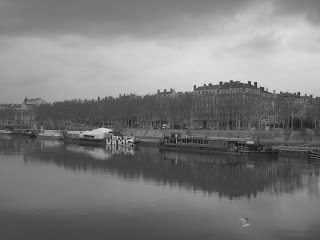
One of my favorite things about Lyon is its color, such a contrast to the Parisian monotone of white/gray limestone. Vieux Lyon is a delicious sorbet-colored palette of rose, orange, peach...even the more Parisian Presqu'ile has shades of pink, blue and yellow, not to mention the many trompe l'oeil frescoes, incredible works of art that often cause viewers to double-take when they catch one decorating the wall of a building. Still, there is something so romantically timeless, so effortlessly vintage and magical about black and white photos, creating a completely different image of the exact same city. Alors, enjoy!
Friday, November 26, 2010
Wednesday, November 24, 2010
Beaujolais Nouveau and Amélie Poulain
Yes yes, these topics seem completely unrelated (except the French connection), but the magic of Lyon has brought them together.
First, the Bea
The big festivities take place in Lyon, the big city in the region, the night before its official release. There is a saying that Lyon actually has three rivers: the Rhône, the Saône and the Beaujolais. Fireworks, free tasting and barrels rolling across the city see the new vintage off in style. Unfortunately, since all of this starts at about 11:45pm, the night before I have to wake up at 6am for work, in a city where buses stop running at midnight, and add to that rain and cold, I was unable to join in this experience.
However, the next evening (enter the Amelie Poulain part), Lindsay and I had bought tickets to see a sneak peek, or avant première of Audrey Tautou's newest film, De vrais mensonges (English title, Full Treatment, which I definitely recommend whenever it comes out in the US or on netflix!), which would be
followed by a q & a with the director (Pierre Salvadori) and three stars, including, evidemment, Audrey Tautou! Anywho, we decided to grab dinner before the movie, but of course we were a little too early for French dinner time (restaurants generally open for/start serving dinner at 7), so we wandered into a grocery store across the street. Not the best idea to distract our starving stomachs. BUT, while sampling some fromage, a man standing next to me asked if we would like to sample his Beaujolais. Baah oui! Bien sûr! And voilà! Beaujolais Nouveau 2010. Check. How was it? you may ask...well, as one lady said during the post-film q & a in response to the same question, "C'est une tradition!" It's a tradition! I think I'll stick with the other local wine--Côtes du Rhône.
De vrais mensonges - Bande annonce VF
envoyé par _Caprice_. - Regardez des web séries et des films.
For the French speakers out there, here is a preview of the movie and then (also if you just like Audrey's voice) here she is talking about her new movie!
Friday, November 12, 2010
Home Sweet Home
It's been a few weeks since my last post--apologies to what are surely thousands of avid readers, waiting with baited breath for new entries (je suis modeste moi!). My excuse is also the subject of this post--I recently got back to Lyon after 10 days of traveling around Germany and France with my dad during my fall break (also known as the vacances de la Toussaint--Nov 1, All Saints' Day, is a national holiday in France and some other European countries).

An even more shocking realization came over me on returning from Paris to Lyon, a realization which really materialized as my dad and I ate dinner with my host family, taking a break from politics to compare France's top two cities. I will always have Paris. It was my first love. Before New York, and before Lyon, there was la ville lumiere. I have far too many memories there--good, bad and all life-changing--and am far too fond of the Eiffel Tower, the Orsay, my Bastille neighborhood and my favorite boulangerie, for anything to change that. Cependent (however), after only a month in Lyon, I found things that bothered me about la capitale, that never had before, and kept hearing myself remark: "Well, in Lyon..." First of all, despite the fact that it was the beginning of November--theoretically the off season--I wanted to murder all of the tourists that were still flooding the city. Granted, I was technically one of these tourists, but after living here twice, I hardly feel that that applies to me anymore, but nonetheless, I had already gotten used to a city ten times (or more) less touristy than Paris. Second, the metro I had always loved so much began to lose some of its hold over me, and I started resenting how much time we spent underground--and how dingy, dirty and crowded it was compared to the metro lyonnais. In Lyon, I normally use a combination of walking, buses and trams--all of which are obviously above ground, and much more scenic than the subterranean metro. Even when I use the metro, rides are generally shorter than in Paris because Lyon is so much more compact--there are only 4 lines, and far few stops on each than in the big city. As my host mom remarked after returning from a weekend in Paris: "The problem with Paris is that you spend so much time underground that it makes you feel like a rat."
I met him in Cologne, Germany where he had gone on a business trip. If any of you are thinking of going to Cologne, don't, unless it's just for 15 minutes to check out the ama
zing and giant cathedral, which seems to be pretty much the only thing that was left standing after WWII. Otherwise, there are many more exciting places to explore in Europe, and in Germany. After that, we spent two days visiting different small towns along the Rhine River, first by train, then on our second day, on a 3 hour boat tour (luckily we didn't meet the same fate as Gilligan and co), on which we saw many a medieval castle and oogled the gorgeous fall colors painting the hills of the valley. With the tourist season there pretty much over, we often had places practically to ourselves, which definitely spoiled us right before Paris, which was still overrun. From there, we went to Paris, did a D-day beaches tour and ended in Lyon, where my dad got to talk politics with my French family, while Oscar (the son) and I did our best to translate words, concepts and cultures. We had a great time, and I even had a few revelations along the way.
First of all, while in Germany, I suddenly became very aware of being an American tourist. It might seem odd that I remarked on such a feeling, when it's not like this was my first, second or even third time traveling to a foreign country, nor even to a country outside of France. Nonetheless, I began to feel like an "ugly American," something I have always done my best to avoid, and criticize whenever I see it
(something I mostly do while in France). It made me realize that perhaps I have been a little unfair to the vast majority of Americans who are not in my special position of speaking the language as well as the culture. Normally, when I travel, I try to "do as the Romans do," and at least say hello and thank you in the native language, but I found it difficult to remember to do so, as I fumbled for the right words, and found myself assuming (whether right or wrong), that everyone spoke English. Spending so much time in France, somethings I forget how overwhelming and even scary it can be to not understand one word that is spoken or written, and hoping that that announcement they just made wasn't important. While it's nice to get out of France for a few days--I thoroughly enjoyed my trip to Amsterdam this summer, and the Rhine Valley was lovely--I can only last for so many days before I start grumbling about getting back to France ASAP. Hey, I need my buttery croissants!
More than ever before, this country is feeling like my home away from home. With the states currently out of the question, France is definitely the next best thing. Though while I'm there, I usually feel a bit out of place and I'm always certain I'm missing something, I'm missing a whole lot more when I'm elsewhere and I realized just how comfortable--and at home--I do feel in France. On the train from Cologne to Paris, I sighed with relief when we crossed the border, and smiled to myself when we reached Gard du Nord, where I could once again read the signs--and, more importantly, the people.
An even more shocking realization came over me on returning from Paris to Lyon, a realization which really materialized as my dad and I ate dinner with my host family, taking a break from politics to compare France's top two cities. I will always have Paris. It was my first love. Before New York, and before Lyon, there was la ville lumiere. I have far too many memories there--good, bad and all life-changing--and am far too fond of the Eiffel Tower, the Orsay, my Bastille neighborhood and my favorite boulangerie, for anything to change that. Cependent (however), after only a month in Lyon, I found things that bothered me about la capitale, that never had before, and kept hearing myself remark: "Well, in Lyon..." First of all, despite the fact that it was the beginning of November--theoretically the off season--I wanted to murder all of the tourists that were still flooding the city. Granted, I was technically one of these tourists, but after living here twice, I hardly feel that that applies to me anymore, but nonetheless, I had already gotten used to a city ten times (or more) less touristy than Paris. Second, the metro I had always loved so much began to lose some of its hold over me, and I started resenting how much time we spent underground--and how dingy, dirty and crowded it was compared to the metro lyonnais. In Lyon, I normally use a combination of walking, buses and trams--all of which are obviously above ground, and much more scenic than the subterranean metro. Even when I use the metro, rides are generally shorter than in Paris because Lyon is so much more compact--there are only 4 lines, and far few stops on each than in the big city. As my host mom remarked after returning from a weekend in Paris: "The problem with Paris is that you spend so much time underground that it makes you feel like a rat."
Lastly, the contrast between the calmer, less touristy, less metro-dependent smaller city and the comparitively crowded and harried capital really struck me. I'm a big city girl through and through, and NYC is still my life-plan, but returning to Lyon, I breathed a second sigh of relief to be back in the provinces (ie the rest of France outside of Paris). Still a big city (second after Paris), life moves a little more slowly down here (I know, it's France, isn't everything slow around here?). Just because the Eiffel Tower is practically the universal symbol for France, doesn't mean that this extraordinarily diverse country can--or should--be reduced to five letters (no I don't mean merde). It's really only outside this city that one can really taste and appreciate the delicious Frenchness of France.
Monday, October 25, 2010
And they lived happily ever after...
Il était une fois...
"Il etait une fois"= Once upon a time
Despite the strikes which caused our train to be canceled, Lindsay and I made it to the Loire Valley, chateaux country! The Loire River is the longest in France and cuts it horizontally. The famous Loire Valley is located in central France, and for a time, stole the royal glory from Paris. In the 16th century, Paris was not the nice place it is today, so the kings of France decided to migrate a bit south and build their magnificent homes along the Loire river. This was also a strategic decision, as the Loire river was the main artery of transportation of goods and people. Thus during the French Renaissance, hundreds of castles were built in this area by kings and nobles, who had of course, like moths to a flame, followed the center of power everywhere, from Paris to the Loire, and later from Paris to Versailles (under Louis XIV in the next century). Many of the chateaux were built on the site of ancient fortifications, and some of the "chateaux" are actually fortresses, and not royal residences, those the latter are of course, the main tourist attraction.
Francois I was the first king to establish the Loire as the new center of France, and w
hile his main residence was the chateau in Amboise (pictured above; also where Leonardo da Vinci spent his last 3 years as architect and painter of the king), he had several other chateaux built, some of which he visited only a handful of times (no wonder France was going bankrupt by the mid 18th century!). Other kings followed suit, and while the money may have been better spent buying peasants bread, luckily for us, there remain many gorgeous chateaux to visit today, allowing us all to feel like kings and queens, if only for a moment.
Addendum to "faire la greve"
In the last week or so, I have read, heard and discussed more about the retirement reform issues and just wanted to add a few things to my previous post.
First of all, now that it is the Toussaint vacation (a 10-day fall break around the Nov 1 "all saints' day" holiday), the strike scene is starting to calm down. To add to this, the Senate has finally voted in the law, and it should become official within the week. However, the unions have called for two more official strike days--Oct 28th and Nov 6th, but those will likely be smaller than previous demonstrations, and hopefully less violent.
For those of you who have seen reports about the violence in France during the strikes, just know that it is not coming from strikers themselves, who are demonstrating peacefully as usual, but from younger, well, delinquents, mostly in the poorer suburbs, many of whom have been coming into the city causing trouble--breaking store windows, melting trashcans, etc. The police have retaliated with tear gas--which, lucky me, I stumbled upon one day. Trust me, not fun. Lyon especially has been the site of many a clash between the police and these troublemakers, but it's really not as dangerous as it may sound, especially if you know the areas to avoid.
On top of this, other big problems caused by strikers are: gas shortages (caused by blocked oil refineries), fewer trains, and even piling trash in Marseille (garbagemen on strike). Many people have canceled their Toussaint travel plans due to these issues, and lines at the gas stations continue to be rather long.
Anyway, back to the issues over the reform. For many, the specific issue of working two years longer is not really the most important; generally I would say those most angry over that are those close to the original retirement age. Rather, this reform (soon to be law) is really just a symbol of the direction in which Sarko has been leading France. Both the straw that broke the camel's back, and a foreboding harbinger of what is to come.
France was a pioneer in the area of "droits sociaux," or social welfare state, and they have some of the best in the world. Like I have said previously, the French are used to and expect these rights given them by the government, and they pay for them as well. With this reform, they see these rights getting chipped away, and especially with Sarko at the head, they fear that they will see more and more rights taken away until France is just like--gasp--the US, which is not exactly a forerunner when it comes to social welfare, and could honestly take some tips from Europe (those socialists!). Since most Americans really know next to nothing about the French president, aside from the fact that he is married to singer and former-model Carla Bruni (trophy wife!), it is perhaps hard to understand the extreme distrust and fear he inspires in many French people--even those who voted for him in 2007 (he currently has an all-time low approval rating of 29%). Just imagine the French equivalent of George Bush (only shorter) and maybe you can understand the problem.
Sarko insists this law is necessary because of the economy. It's not that the French can't understand that the economy is still in trouble. However, this law hits those already struggling because of this economy, rather than those (like Sarko and his cronies) who could stand to lose a few euros. The point is to try to find a solution that isn't targeting the middle and lower classes, ie the majority of the country (hence the general outrage). Even members of parliament don't want this reform for their own retirement, having rejected just this in early September. If this reform is so unavoidable and mild, why would they refuse it for themselves? The rich get richer while the poor get poorer. One of Sarko's slogans in 2007 was "Travailler plus pour gagner plus!" (Work more to earn more!). Well, people are working more and earning less. Well, taking his own advice, Sarko too is workisng more (to piss people off) and earning less (approval).
All of that said, I am looking forward to the end of this constant strike state--it definitely gets tiresome after a few weeks. As it looks like the passage of the law is now inevitable, hopefully France will soon return to "normal." Then they can put all of their energy into electing a president from the left in 2012 (looking iffy at best right now, despite Sarko's unpopluarity) and hope that he/she will repeal this law, or at the very least, halt the trend towards less social rights.
Wish me luck for my train to Cologne (and to my dad) on Thursday!
First of all, now that it is the Toussaint vacation (a 10-day fall break around the Nov 1 "all saints' day" holiday), the strike scene is starting to calm down. To add to this, the Senate has finally voted in the law, and it should become official within the week. However, the unions have called for two more official strike days--Oct 28th and Nov 6th, but those will likely be smaller than previous demonstrations, and hopefully less violent.
For those of you who have seen reports about the violence in France during the strikes, just know that it is not coming from strikers themselves, who are demonstrating peacefully as usual, but from younger, well, delinquents, mostly in the poorer suburbs, many of whom have been coming into the city causing trouble--breaking store windows, melting trashcans, etc. The police have retaliated with tear gas--which, lucky me, I stumbled upon one day. Trust me, not fun. Lyon especially has been the site of many a clash between the police and these troublemakers, but it's really not as dangerous as it may sound, especially if you know the areas to avoid.
On top of this, other big problems caused by strikers are: gas shortages (caused by blocked oil refineries), fewer trains, and even piling trash in Marseille (garbagemen on strike). Many people have canceled their Toussaint travel plans due to these issues, and lines at the gas stations continue to be rather long.
Anyway, back to the issues over the reform. For many, the specific issue of working two years longer is not really the most important; generally I would say those most angry over that are those close to the original retirement age. Rather, this reform (soon to be law) is really just a symbol of the direction in which Sarko has been leading France. Both the straw that broke the camel's back, and a foreboding harbinger of what is to come.
France was a pioneer in the area of "droits sociaux," or social welfare state, and they have some of the best in the world. Like I have said previously, the French are used to and expect these rights given them by the government, and they pay for them as well. With this reform, they see these rights getting chipped away, and especially with Sarko at the head, they fear that they will see more and more rights taken away until France is just like--gasp--the US, which is not exactly a forerunner when it comes to social welfare, and could honestly take some tips from Europe (those socialists!). Since most Americans really know next to nothing about the French president, aside from the fact that he is married to singer and former-model Carla Bruni (trophy wife!), it is perhaps hard to understand the extreme distrust and fear he inspires in many French people--even those who voted for him in 2007 (he currently has an all-time low approval rating of 29%). Just imagine the French equivalent of George Bush (only shorter) and maybe you can understand the problem.
Sarko insists this law is necessary because of the economy. It's not that the French can't understand that the economy is still in trouble. However, this law hits those already struggling because of this economy, rather than those (like Sarko and his cronies) who could stand to lose a few euros. The point is to try to find a solution that isn't targeting the middle and lower classes, ie the majority of the country (hence the general outrage). Even members of parliament don't want this reform for their own retirement, having rejected just this in early September. If this reform is so unavoidable and mild, why would they refuse it for themselves? The rich get richer while the poor get poorer. One of Sarko's slogans in 2007 was "Travailler plus pour gagner plus!" (Work more to earn more!). Well, people are working more and earning less. Well, taking his own advice, Sarko too is workisng more (to piss people off) and earning less (approval).
All of that said, I am looking forward to the end of this constant strike state--it definitely gets tiresome after a few weeks. As it looks like the passage of the law is now inevitable, hopefully France will soon return to "normal." Then they can put all of their energy into electing a president from the left in 2012 (looking iffy at best right now, despite Sarko's unpopluarity) and hope that he/she will repeal this law, or at the very least, halt the trend towards less social rights.
Wish me luck for my train to Cologne (and to my dad) on Thursday!
Monday, October 11, 2010
Faire la grève
"Faire la grève"= to go on strike.
"grèviste"=someone on strike.
"syndicat"=labor union.
It's finally here, the one you've all been waiting for with baited breath...my blog about France's favorite pastime: striking. Even the chiens (dogs) go on strike here: "Grammy, 67 years old, still here to serve us!"
Along with wearing berets, walking around with baguettes, and playing a rousing g
Anywho, since then, the French have not hesitated to faire la grève whenever a controversial reform is proposed, especially when it has to do with changes to retirement law. I remember back in 2007, while studying in Paris, several strikes broke out throughout the year, preventing some students from getting to class, and putting a bit of a wrench in my weekend trip to the Alps, as strikes often end up involving transportation personnel. While I don't remember the exact issue being protested, it was definitely related to la retraite (retirement). This time around, the strikes are even more ferocious and and the strikers perserverant. Sarko (Nicolas Sarkozy, the French president, and I say that with all the disdain I would when mentioning our former president) is trying to reform the retirement laws, changing the retirement age from 60 to 62, and the age when they can receive full benefits from 65 to 67. He believes this will help alleviate some of the government's economic problems, still struggling to recover from the recession.
As teachers' unions are the largest in the nation, this has meant some missing teachers on big strike days--thus less work for moi!
A few grevistes gathered in Place Bellecour,
a popular spot for demonstrations in Lyon
To Americans, brainwashed by the Puritan work-ethic on which our nation was founded (and with which it has since prospered), all of their commotion over this reform falls on deaf ears, and many probably look at the French and roll their eyes while calling them lazy, or as my dad said: "Tell them to stop whining." This, along with their "35-hour" work week (which doesn't apply to everyone, btw), 5 weeks of paid vacation (vs our maybe 2 weeks), and (exaggerated) 2 hour lunches, can paint a false picture of the French for those who know little or nothing about their
culture, and fail to realize that despite the fact that, yes France is also part of the Christanized, Occidental world, it has a history, and therefore mentality, completely different from our own. (Refer to 60 Million Frenchmen Can't Be Wrong for an excellent read on the subject).
They don't want the retirement age to change because they have in fact worked very hard for 40+ years and don't want to wait another 2 years, especially when this has been the norm since Mitterrand lowered the age from 65 to 60 in 1982. They would like to relax and enjoy life while they still have all their teeth and can remember what day it is. Who wouldn't like to retire earlier? This is especially ennervating for people on the verge of retirement--suddenly they are being told they have to wait a couple of years longer. Young people--college and high school students--are also joining the strike. First of all, if people are working two years longer, then prevents jobs from opening to young graduates. As if the job market weren't already difficult enough. Secondly, many feel the need to join in solidarity with their teachers, mothers, uncles, etc, and hopefully keep the status quo for them and for themselves in the future.
One last important side note, retirement works differently in France and the US, which I found myself struggling to explain to a bunch of confused high schoolers the other day (especially since I wasn't even totally clear on the issue). In the US, though we do have Social Security, most people save their own money for retirement. Thus, they can technically retire whenever they feel they have enough money (they just won't receive Social Security until around 66). In France, retirment is all based on something similar to our Social Security, so unless you are super rich, you have to wait to retire until the government says you can. As is quite common, things that are handled privately in the US--health care (grr), retirement, even museums (with the exception of the Smithsonian museums in DC)--are handled by the government in France (and many other European nations). Across the ocean, we have always been terrified of big government and anything that smells of socialism (dare I even metion the other -ism?). From the "Red Scare" in the 1920s, to Blacklisting in the 1950s, to calling Obama Hitler, this country has consistently proved hostile such ideas. In France, though, the government is expected to handle almost everything--and the French pay good money for it too. And they're about to pay two more years of their life.
Sous les pavés, la plage!
--Under the cobblestones, the beach! (A famous slogan from the 1968 student revolution).
Subscribe to:
Posts (Atom)